My Alchemical Vessel: Opening Friday, October 30 from 6-8pm

Photo by Blossom Berkofsky
My Alchemical Vessel at DIMIN
October 30 - December 5, 2026
Opening Reception: Friday, October 30, 6-8pm
406 Broadway, Fl. 2, New York, NY
DIMIN is pleased to present My Alchemical Vessel, a new series of paintings by Emily Coan, marking a significant shift in the artist’s practice. Moving away from the female figures and Hudson Valley landscapes that have defined her recent work, Coan turns inward, depicting the interiors of her in-laws’ 18th-century farmhouse in Ghent, New York. Built around the time of the American Revolution, the farmhouse becomes both setting and subject: a repository of family history, a site of inheritance, and a space through which the artist considers the experience of entering midlife as a woman.
Rather than constructing imagined environments for her figures, Coan begins with a specific, lived space and allows its history to shape the paintings. In these intimate domestic vignettes, the home becomes a microcosm through which she considers the tension between inherent expectations and the possibility of constructing a new identity. The domestic interior, traditionally associated with feminine labor and stability, is understood here as a space that can simultaneously provide security and impose limitations. As Coan depicts an environment she will one day occupy, she reflects on what it means to inherit not only a physical structure, but also the histories, obligations, and identities it contains.
Coan’s multilayered oil paintings retain her sensitivity to atmosphere, light, and the psychological possibilities of space, while introducing a quieter and more intimate visual language. Her interest in European genre painting is evident in a recollection classical tradition, with dramatic chiaroscuro, deep shadows, and the warm glow of candlelight. References to Vermeer, Georges de La Tour, and Jan van Eyck are apparent in the way light transforms ordinary interiors into spaces of heightened psychological and spiritual significance. Yet within these traditional compositions, Coan embeds personal and distinctly contemporary details: an empty Doritos bag, a box of tarot cards, an iPhone. These objects appear almost casually within the scenes, their familiarity contrasting with the paintings’ historical atmosphere. In plain sight, they introduce traces of Coan’s own life and the present moment, subtly disrupting the sense that these rooms exist outside ordinary time. The resulting imagery occupies a space between past and present, where the domestic environment becomes both a psychological landscape and a record of contemporary life.
The title, My Alchemical Vessel, draws on the language of alchemy, imagining the farmhouse itself as a vessel undergoing “nigredo”, the first stage in the creation of the Philosopher’s Stone. Drawing on Marie-Louise von Franz’s writing on alchemy, Coan contemplates nigredo as a necessary stage of transformation, in which the existing self undergoes darkness, decomposition, and dissolution before something new can emerge. Von Franz translated the religious concept of the “dark night of the soul” (originally coined by 16th-century mystic St. John of the Cross) into the language of depth psychology and alchemy. For Coan, this phrase becomes a metaphor for midlife and the unstable passage between identities. The house is at once container, crucible, and witness, holding generations of history while becoming the site of Coan’s own transformation.
As in Coan’s earlier work, the subjects are drawn from her friends and family, each embodying different aspects of the artist’s own experience. Coan appears only once herself, in the large work Nigredo, yet there is a strong personal parallel to the characters of Louisa May Alcott’s Little Women. In Meg, as she embraces domestic happiness and traditional love; in Amy, as she pursues artistic refinement and maturity; and even in Laurie, whose search for belonging echoes Coan’s own experience of finding her place within her in-laws’ family and home. Gabriel García Márquez’s One Hundred Years of Solitude provides another literary point of reference, particularly in its treatment of family, inheritance, memory, and the cyclical nature of time. Together, these influences deepen Coan’s exploration of the home as a space where generations overlap and personal histories overlap, and identity is shaped by what has been passed down.
My Alchemical Vessel marks a new chapter in Coan’s ongoing investigation of femininity, power, and transformation. Where her earlier paintings placed female figures within fantastical landscapes, these works locate transformation inside the walls of a home. The movement from the imagined to the all-too real, brings the psychological and symbolic concerns of her earlier work into a deeply personal environment. Citing anxieties about disappearing as a woman under the pressures of midlife, Coan grapples with how to “become something powerfully new when pressure from all sides threatens to burn you up”. The paintings hold this tension between dissolution and emergence, asking what might remain when an inherited identity can no longer contain the person becoming it. In this sense, the farmhouse is not simply a backdrop for transformation, but the place where Coan confronts the possibility of being remade by the very forces that threaten to consume her.
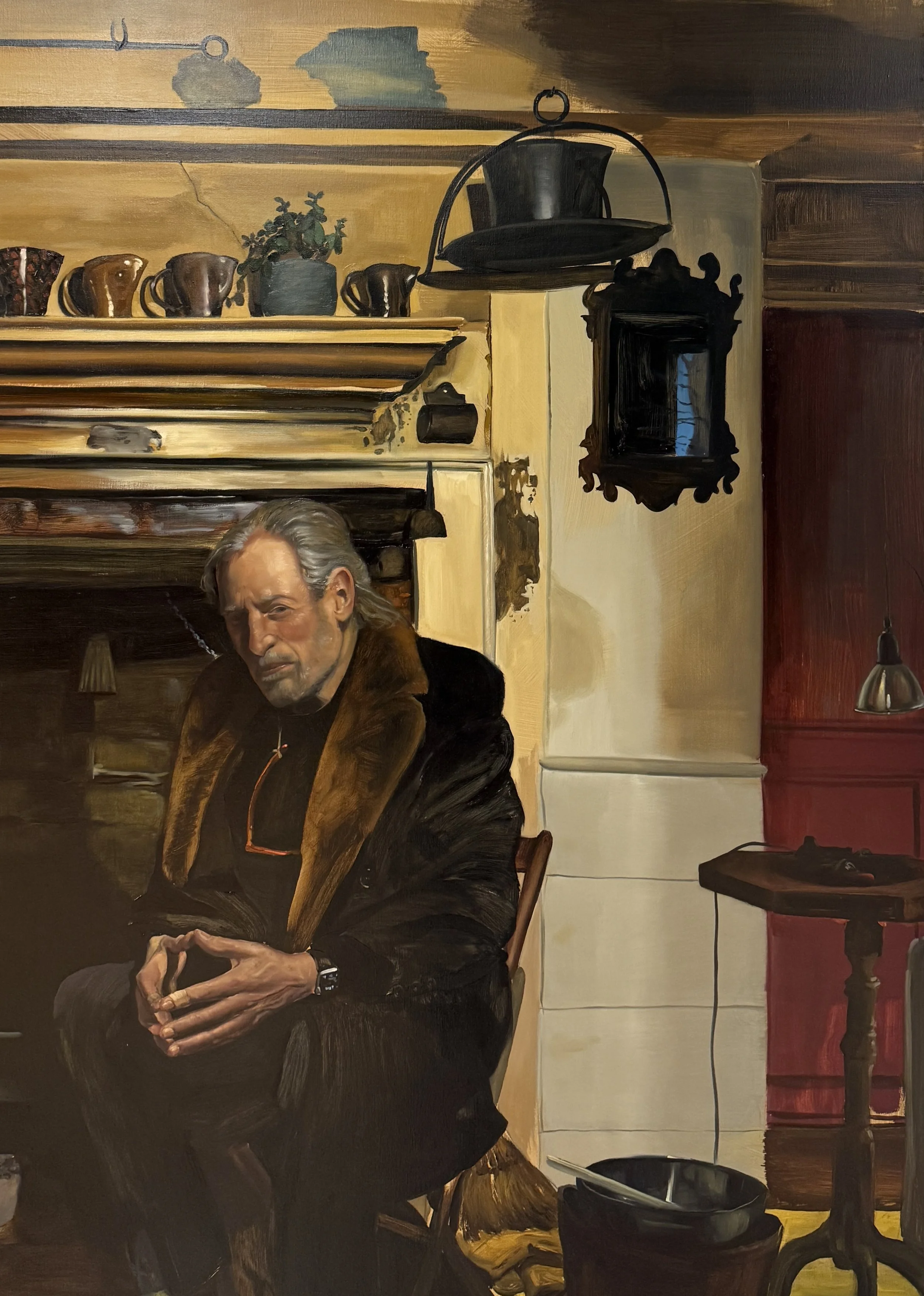
Detail of Nigredo, 2026. Oil on linen. 55 × 82 in (140 × 208 cm)